
New Zealand Mudsnail (NZMS)
(Potamopyrgus antipodarum)
*Detected in Michigan*
WATCH LIST - PROHIBITED IN MICHIGAN
WHAT TO LOOK FOR
Small snail, averaging 1/8 inch long.
Right-side opening with 5-6 whorls on shell.
Shells vary from light brown to black.
Difficult to identify.
REPORT NEW ZEALAND MUDSNAIL
If possible, please take one or more photos of the invasive species you are reporting. Also make note of the location, date and time of the observation. This will aid in verification of your report. You may be asked to provide your name and contact information if follow-up is needed.
Contact Justin Bopp, DNR BoppJ@Michigan.gov, 517-420-9110, or Bill Keiper, EGLE keiperw@michigan.gov.
Or use the Midwest Invasive Species Information Network (MISIN) online reporting tool.
Or download the MISIN smartphone app and report from your phone.
ABOUT THIS SPECIES:
Habitat: New Zealand mud snails can tolerate a wide variety of habitats, including reservoirs, estuaries, rivers, and lakes. They are most prolific in water bodies with a constant temperature and flow, but are highly adaptable.
Native Range: New Zealand.
U.S. Distribution: Western United States, Great Lakes and the Chesapeake Bay.
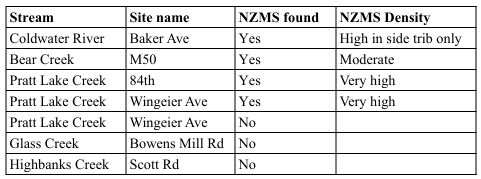
Michigan Distribution: New Zealand mudsnail populations are present in the Au Sable, Boardman, Grass, Pere Marquette, Pine and Upper Manistee rivers in Michigan.
Michigan Status: New Zealand mudsnails are prohibited in Michigan.
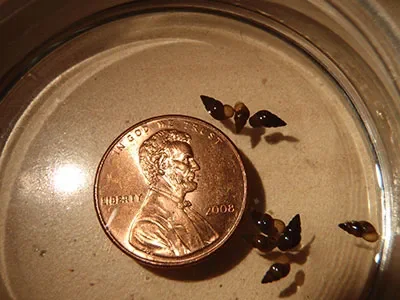
New Zealand mudsnails are small and brown to black in color. Photo courtesy of Michigan EGLE.
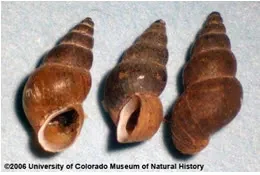
Shells have 5-6 whorls and open on the right side. Photo courtesy of University of Colorado Museum of Natural History.
What you can do:
Always Clean, Drain, and Dry your waders, boots, boats and other gear between trips or before moving to a new body of water. Take extra precaution in areas with known or suspected didymo or New Zealand mudsnail infestations. In addition to removing debris and mud, the State of Michigan recommends using a chemical disinfectant to achieve maximum decontamination for didymo and New Zealand mudsnail. Possible disinfectants with documented effectiveness for these species include:
Products such as Formula 409® Antibacterial All-Purpose Cleaner applied to waders and gear.
Bleach: Apply a solution of ½ cup (4 fluid ounces) bleach to 5 gallons of water and let stand for 20 minutes.
Virkon Aquatic: Apply a solution of 20 grams per liter of water and let stand for 20 minutes (see manufacturer’s label for additional guidance).
Any chemical disinfectants should be applied to waders and gear on land, at a reasonable distance from the water, to avoid accidental discharge into surface waters.
These methods work for didymo, New Zealand mudsnails and most other aquatic invasive species.
Helpful Tips:
Avoid visiting multiple rivers in a single day.
Plan time to decontaminate between trips.
Designate specific gear, especially porous items like nets or rope, for use only in infested waters.
MORE INFORMATION:
Status and Strategy for New Zealand Mudsnail Management - (archived). This document provides in-depth information about New Zealand mudsnail in Michigan including identification, distribution, management and control options.